October 10, 2025
At The Kinship Fund, we’re working to change the way philanthropy operates. Too often, funders set the terms and nonprofits are left to fit themselves into rigid boxes. We believe in something different: trust-based philanthropy that centers relationships, transparency and true partnership through unrestricted multi-year funding and support beyond the check.
That’s why we’re so interested in the work of UpMetrics, a social impact organization that helps nonprofits and funders use data to tell their stories, learn from each other and build stronger collaborations. Together, we share a belief that when philanthropy shifts from transactional to relational, communities become more resilient.
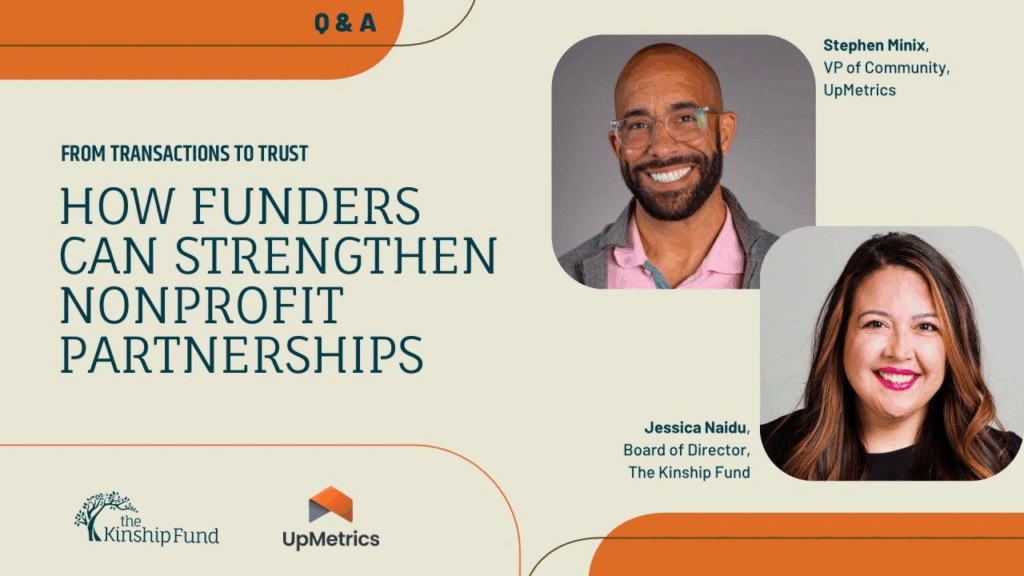
In this conversation, The Kinship Fund sits down with Stephen Minix, Vice President of Community at UpMetrics, to talk about collaboration between funders and nonprofits — why it matters, what gets in the way and how both sides can do better.
Q: How did you first get into this work?
Stephen: Honestly? Because I lost $8 million. I was running after-school programs for a big school district, serving about 12,000 kids in Los Angeles. We applied for a grant, but the California Department of Education told us we lacked an effective data strategy. We didn’t get the funding, and those programs disappeared. I was pissed.
I’m an athlete at heart, so when I lose, I don’t quit — I figure out how to play the game better. I became a fundraiser overnight, duct taping partnerships together so kids would still have something. Eventually, we won the funding back, but by then I knew I wanted to work beyond the school system. I linked up with folks in philanthropy who were tired of just buying more soccer goals and helmets, and that turned into what I do now: helping nonprofits and funders use data to actually collaborate.
Q: Why is collaboration between funders and nonprofits so essential?
Stephen: Think about trying to play ping pong by yourself. Short game, right? Social change is a team sport. Funders have capital. Nonprofits have the lived experience and the staff to deliver programs. If you don’t have a teammate, you’re a lot less likely to be effective. Neither can succeed without the other.
Too often, though, philanthropy keeps things locked behind gatekept applications and annual reports. That creates a weird dynamic where nonprofits are forced to look perfect on paper just to get funding, instead of building real relationships. Collaboration is the only way to get to real impact. Without it? The chances of success are basically zero.
Q: Can you share a time when collaboration didn’t go well?
Stephen: Oh yeah! Collaboration isn’t kumbaya — it’s people working together, and people are messy.
At its core, collaboration means giving up something. If consensus is the destination, then you have to sacrifice a little control, a little ego, to get there.
The problem in philanthropy is that funders often don’t give up anything. Funders set the terms, nonprofits comply, and then we call it collaboration. But that’s not collaboration. Real collaboration is being in the canoe and rowing together in the same direction.
Last year, at a big funder–nonprofit convening, I literally had to break up a fistfight. A funder had hired a consultant to collect data from nonprofits, but there was no communication about why. One nonprofit leader felt disrespected — like, who are you to demand this when we’ve never even met? — and it exploded.
That’s what happens when we rush to outcomes and skip the basics of trust-building. You can’t just show up, set the terms, and call it collaboration. You’ve got to be willing to give of yourself, to listen, to row in sync. Otherwise, you’re just pulling in opposite directions.
Q: What prevents nonprofits from collaborating with each other or with foundations?
Stephen: Two big things: scarcity and ego.
Nonprofits are resource-strapped. If I’m constantly hustling for the next grant just to keep the lights on, I don’t have time to slow down and build relationships. And if I introduce a peer organization to my funder, I might fear losing that support, so we end up guarding our Rolodex instead of collaborating.
Then there’s ego. Some folks launch foundations not out of passion but because their financial advisor said it was a good legacy move. That kind of mindset makes it hard to “play nice in the sandbox.” At the end of the day, survival instincts kick in — but that comes at the expense of the community.
Q: On the flip side, why don’t more funders actively foster collaboration?
Stephen: Same answer: ego. Funders often like to do what they can do, not necessarily what they should do. They’ll say, “We want nonprofits to collaborate,” but then define that in vague or even contradictory ways.
Real collaboration would mean asking nonprofits what they actually need, and then funding that. For example, providing a menu: “Here are five ways we could support collaborative work. Which ones resonate with you?” That’s very different from funders deciding in advance what capacity to build and forcing nonprofits into those boxes.
Q: What about the power imbalance — can that dynamic ever change?
Stephen: Power doesn’t go away. Funders will always have money and networks; nonprofits will always have the community expertise. The key is to harness that power, not ignore it.
A great example is the 1803 Fund in Portland, which is rebuilding a historically Black neighborhood displaced by development. Yes, they had a $400 million investment from Nike’s Phil Knight, but they also brought in Nike’s marketing team and storytelling power. That kind of holistic partnership changes the dynamic — it’s not just writing checks, it’s bringing the full toolbox.
And funders can make small shifts that matter: hold meetings in community spaces instead of boardrooms, stop hosting panels with only funders on stage and show up ready to listen. Those gestures move the needle on trust.
Q: How should success be measured in collaborative efforts?
Stephen: Success looks different depending on the goal. One Chicago collaboration focused on increasing gainful employment for Black men on the South Side. For them, success was straightforward: more men employed, period.
Other times it’s more complex, like reducing recidivism. That’s where shared frameworks help: Who are you serving? What are you providing? Is anyone better off? And how does that connect to the broader community? That’s a lot of what we do at UpMetrics, and other people do similar type of work too, is we specifically help folks look at impact frameworks.
The main thing is to track progress over time, together. Have honest check-ins. Pivot if something’s not working. And don’t just claim wins individually — celebrate them collectively.
Q: How does the philanthropic space need to change to better support nonprofits?
Stephen: De-center yourself. Stop making philanthropy the hero of the story. Nonprofits are the ones doing the hard, genius work. Funders should be proud partners — yes, your capital makes it possible, but the spotlight belongs on the people delivering impact every day.
Also, fund more than programs. Fund people. Fund professional development, but don’t only fund the executive director. Fund the middle manager in those nonprofits. Resource them up. Get them skills so that they stay sticky in their work. Fund sabbaticals. Cut the check and get out of the way. Give unrestricted support and trust nonprofits to define success. That’s what trust-based philanthropy really looks like.
You must work with each other. You must look at this as a relay race or as a team sport where I need you, you need me. Let’s be clear on what we’re trying to do and work together to make it happen, with some candor and transparency along the way.
Want to go deeper?
This conversation only scratches the surface of what’s possible when funders and nonprofits truly collaborate. For practical strategies, examples, and tools you can put into action, check out UpMetrics’ free guide: Building Resilience Through Collaboration.